What Are the 12 Houses in Vedic Astrology?
A beginner's guide to the bhāvas — what a house actually means, how the Ascendant builds the whole structure, and how to read one in a real chart.
Most people who open a birth chart for the first time look for the planets. That's natural — planets have personalities, and everyone wants to know where their Moon is. But a planet on its own tells you very little. Saturn in a chart is like knowing that a strict, patient teacher has walked into a building. The useful question is: which room did he walk into?
Those rooms are the houses, or bhāvas. They are the part of the chart that answers where — where in your life a planet's energy actually shows up. Learning them is the fastest way to move from horoscope-column astrology to reading a real chart.
What a Bhāva Actually Means
The Sanskrit word bhāva is usually translated as "house," but it literally suggests a state of being or a mode of existence. Each bhāva is a slice of the sky measured from the moment and place of your birth, and each slice is assigned a set of life topics.
Two things are worth getting clear right away. A house is not a physical object in the sky — it is a division of space created by the horizon and the Earth's rotation. And a house is a container of meaning, not an event. The 7th house doesn't cause marriage; it's the area of the chart where partnership matters get read.
Every house holds a cluster of related topics. The 4th house, for example, covers mother, home, land, vehicles, formal education, and inner emotional security. These may look unrelated in English, but they share a common thread: the foundations you rest on.
The Ascendant: Where the Whole Structure Begins
Here is the part that surprises beginners. Two people born on the same day have nearly identical planetary positions — the Moon moves about 13° a day, everything else far less. Yet their charts can read completely differently.
The reason is the Lagna, or Ascendant: the zodiac sign rising over the eastern horizon at the exact moment of birth.
Because the Earth rotates once every twenty-four hours, the entire zodiac passes across the eastern horizon each day. A new sign rises roughly every two hours. That rising sign becomes the 1st house, and the remaining houses follow in zodiacal order.
In the whole-sign system used across most of traditional Vedic astrology, the arrangement is simple:
Next sign → 2nd house
Next sign → 3rd house
...
Twelfth sign → 12th house
So if Aries rises, Aries is the 1st house, Taurus is the 2nd, Gemini the 3rd, and so on around the circle. Shift the birth time by two hours and the entire framework rotates — the same planets now sit in different houses and describe a different life.
This is why an accurate birth time matters more than almost anything else in chart reading.
Why Twelve?
There are twelve houses because there are twelve signs, and the house framework is built by laying the rotating zodiac against the fixed horizon. The Sun's yearly path — the ecliptic — is divided into twelve equal 30° signs, so dividing the same circle from the Ascendant naturally yields twelve divisions.
Twelve also happens to be practical. It gives enough categories to separate distinct life themes — siblings from children, work from partnership — without fragmenting a chart into unreadable pieces.
The Twelve Houses at a Glance
| House | Sanskrit Name | Main Meaning |
|---|---|---|
| 1st | Tanu Bhāva | Body, appearance, personality, vitality, overall life direction |
| 2nd | Dhana Bhāva | Wealth, savings, speech, food, immediate family |
| 3rd | Sahaja Bhāva | Younger siblings, courage, effort, skills, short travel, communication |
| 4th | Sukha Bhāva | Mother, home, land, vehicles, schooling, emotional comfort |
| 5th | Putra Bhāva | Children, creativity, intelligence, romance, past merit (pūrva puṇya) |
| 6th | Ripu Bhāva | Illness, debts, enemies, competition, daily work, service |
| 7th | Kalatra Bhāva | Marriage, spouse, business partners, contracts, the public |
| 8th | Āyu / Randhra Bhāva | Longevity, transformation, inheritance, hidden matters, research |
| 9th | Dharma Bhāva | Father, teachers, higher learning, ethics, long journeys, fortune |
| 10th | Karma Bhāva | Career, reputation, status, action in the world |
| 11th | Lābha Bhāva | Gains, income, friends, networks, elder siblings, fulfilled wishes |
| 12th | Vyaya Bhāva | Expenses, loss, foreign lands, seclusion, sleep, spiritual release |
These are the natural significations of the houses — the topics each house owns before any planet is placed in it.
Natural Significators (Kārakas)
Alongside house topics, each area of life also has a planet traditionally treated as its natural significator, or kāraka. Commonly cited associations include the Sun for status and authority, the Moon for the 4th house (mother and emotional comfort), Mars for the 3rd (courage and effort), Jupiter for wealth, children, wisdom and gains, Venus for the 7th (marriage), Mercury for skill and communication, and Saturn for the 6th, 8th and 12th (labour, longevity, loss).
Different classical and modern sources vary on the finer details here, so treat kārakas as a supporting layer rather than a rigid rule. Practically, they give you a second place to look: to assess marriage you'd examine the 7th house, its lord, and Venus.
Houses vs. Signs vs. Planets
Beginners often blur these three. A simple way to hold them apart: House is the area of life — where the story happens. Sign is the style or flavour — how it happens. Planet is the actor — who is doing it.
A house and a sign are not the same thing even when they overlap. Scorpio is always intense; the 8th house is always about hidden and transformative matters. If Scorpio happens to be your 8th house, those qualities reinforce each other — but for someone with Gemini rising, the 8th house is Capricorn, and the same life area takes on a slower, more structured tone.
Signs and planets are universal. Houses are personal, because only your birth time and place determine them.
Angular, Succedent and Cadent Houses
The twelve houses fall into three groups of four, based on their distance from the Ascendant.
| Group | Sanskrit | Houses | Simple Meaning |
|---|---|---|---|
| Angular | Kendra | 1, 4, 7, 10 | Pillars of the chart — visible, active, structural |
| Succedent | Panaphara | 2, 5, 8, 11 | Resources and sustenance — what supports and follows |
| Cadent | Apoklima | 3, 6, 9, 12 | Learning, effort and release — transition and change |
Kendras are considered the strongest houses. They describe the framework of a life: self, home, partnership, career. Planets here tend to express themselves openly.
Panapharas hold what accumulates — money, children, inheritance, gains.
Apoklimas are about movement and letting go — skill-building, service, philosophy, withdrawal.
Two other groupings appear constantly in Vedic texts. The trikonas (1st, 5th, 9th) relate to dharma and are treated as auspicious. The duḥsthānas (6th, 8th, 12th) relate to difficulty, effort and loss — though in practice they also govern healing, research and spiritual life, so "bad house" is a lazy translation.
Why House Lords Matter
Every house is occupied by a sign, and every sign has a ruling planet. That planet becomes the house lord (bhāveśa or bhāvādhipati) — the manager of that department of life.
This creates connections across the chart. Wherever the house lord sits, it links the two houses together.
Suppose the lord of your 10th house (career) is placed in your 7th house (partnership). A reasonable reading is that your professional life is likely to involve working with others, clients, or a business partner. Nothing is guaranteed — but the direction of the story is indicated.
House lords matter because a house can be empty. With twelve houses and nine grahas, at least three houses in every chart contain no planets. An empty house is not a blank life area; you simply read it through its lord.
How Planets in Houses Are Read
When a planet occupies a house, a useful beginner's formula is: planet's nature + house's topics = the theme to explore.
Mars in the 3rd house: Mars is drive and assertion; the 3rd is courage and effort. Read it as strong initiative, competitive skill, possibly friction with siblings.
Saturn in the 7th: Saturn is delay, duty and endurance; the 7th is partnership. Read it as a serious approach to commitment, often later marriage, or a partner who is older or responsibility-minded.
Then refine with three questions: What sign is the planet in? Which houses does it rule? What else aspects or sits with it? Never judge a chart from one placement.
A Worked Example
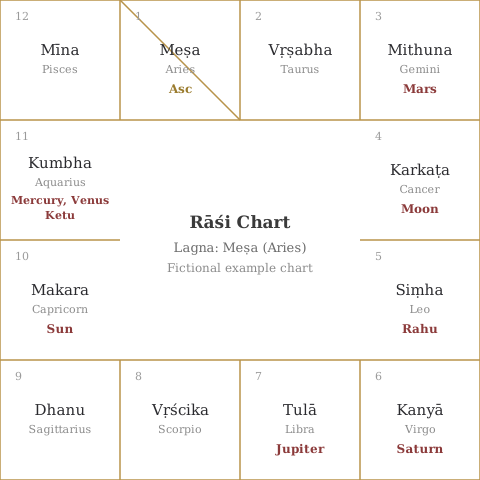
Here is a fictional chart in the South Indian format, where the signs stay in fixed positions and the Ascendant is marked. Our subject has Aries rising.
A beginner-level reading:
Sun in the 10th house. The Sun signifies status and visibility; the 10th is career. A person likely to seek recognition through work and take on leadership.
Moon in the 4th house. The Moon is at home in the 4th, its natural house. Strong emotional attachment to family, home and roots.
Mercury and Venus in the 11th. Communication and social grace directed toward friendships, networks and income.
Saturn in the 6th. Saturn handles hard, sustained work well; the 6th is service, competition and daily routine. Endurance in difficult circumstances.
Jupiter in the 7th. Jupiter, generally benefic, in the house of partnership suggests a supportive spouse or ethical business relationships.
The 1st house is empty. Not a problem. Its lord is Mars, ruler of Aries, placed in the 3rd — pointing to a self-image built around courage, effort and skill.
House → Life Area → Simple Example
| House | Life Area | Simple Everyday Example |
|---|---|---|
| 1st | Self and body | How you come across when you walk into a room |
| 2nd | Money and speech | Your savings account; the way you talk to people |
| 3rd | Effort and siblings | Learning a new skill; a weekend trip to the next city |
| 4th | Home and mother | Buying a house; your childhood bedroom |
| 5th | Creativity and children | Writing a song; your child's school play |
| 6th | Work and health | A demanding job; recovering from an illness |
| 7th | Partnership | Getting married; signing a business contract |
| 8th | Transformation | An inheritance; a life-changing crisis |
| 9th | Beliefs and teachers | A mentor who changed your thinking; a pilgrimage |
| 10th | Career and status | A promotion; your professional reputation |
| 11th | Gains and friends | A bonus at work; a supportive circle of friends |
| 12th | Loss and solitude | Living abroad; a silent meditation retreat |
Where to Go From Here
Once the houses make sense, the rest of chart reading has somewhere to stand. Signs describe style, planets describe agency, but houses tell you which part of a life is actually being discussed.
A good next step is to find your own Ascendant using an accurate birth time, list which sign falls in each house, and note where each planet sits. Even that simple exercise, done carefully, teaches more than reading a hundred general descriptions.