What Is the Ascendant in Vedic Astrology?
Almost every structural feature of a Vedic chart depends on a single rising point. Here is what the Ascendant is, how it is found, and why it matters so much.
If you have ever had your birth chart drawn up, you may have noticed that an astrologer asks for something a Sun sign horoscope never needs: your exact time of birth, down to the minute, and the city where you were born. There is a reason for that. Almost every structural feature of a Vedic chart depends on a single point called the Ascendant, and that point cannot be found without those two details.
In Sanskrit the Ascendant is called the Lagna, from a root meaning "attached" or "fastened." It is the point where the sky attaches itself to your particular moment and place of birth. Everything else in the chart is then arranged around it.
This article looks only at the Ascendant: what it is, how it is calculated, what it represents, and how to spot it in a chart.
The Ascendant in One Sentence
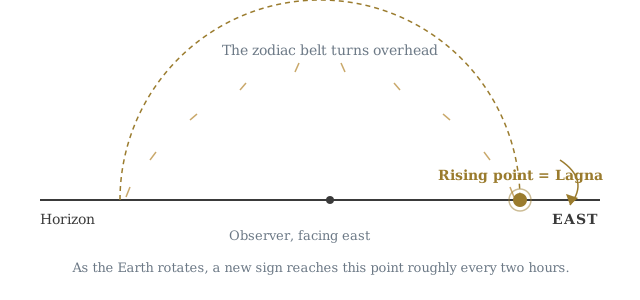
The Ascendant is the zodiac sign that was rising on the eastern horizon at the exact moment and place of your birth.
Picture standing outside at the moment you were born and looking due east. The Sun, the Moon and the planets sit somewhere in the sky, but the eastern horizon itself is also pointing at a particular part of the zodiac. That part is your Lagna.
Because the Earth spins on its axis roughly once every 24 hours, this eastern point sweeps through all twelve signs in the course of a day. It is not the planets moving quickly. It is the ground under your feet turning.
How the Ascendant Is Calculated
Three inputs are needed:
1. Date of birth — tells us where the Sun and planets were in the zodiac.
2. Time of birth — tells us how far the Earth had rotated that day.
3. Place of birth — gives the latitude and longitude, which determine where "east" actually points and how the zodiac is tilted relative to that horizon.
An astrologer (or software) converts the birth time to a standard reference, works out the local sidereal time, and from that calculates the exact degree of the zodiac rising on the eastern horizon. Vedic astrology uses the sidereal zodiac, measured against the fixed stars, so the calculation includes a correction called the ayanāṃśa. This is why a Vedic Ascendant may differ from a Western one for the same birth data.
Why Minutes Matter
The Ascendant moves at roughly one degree every four minutes, which means about 30 degrees, or one full sign, every two hours on average. The exact speed varies with latitude and with the sign involved, since some signs rise more quickly than others.
Two practical consequences follow. A birth time that is off by fifteen or twenty minutes usually keeps the same Ascendant sign, but shifts its degree, which can change other chart details. A birth time that is off by an hour or two can change the Ascendant sign entirely, and with it the entire house structure of the chart.
Place matters for the same reason. A birth at 6:00 a.m. in Delhi and one at 6:00 a.m. in Chennai are not the same sky. Different latitude, different horizon, potentially a different Lagna.
If your recorded birth time is uncertain, an astrologer may attempt birth time rectification, working backwards from known life events to narrow down the likely time. It is an estimate, not a certainty, and it is worth being honest with yourself about how reliable your recorded time actually is.
Ascendant, Sun Sign and Moon Sign
Most people meet astrology through Sun signs. In Vedic astrology, the Sun sign is only one of three commonly used reference points, and it is usually the least emphasised of the three.
| Ascendant (Lagna) | Moon Sign (Chandra Rāśi) | Sun Sign (Sūrya Rāśi) | |
|---|---|---|---|
| Based on | Sign rising in the east at birth | Sign the Moon occupied at birth | Sign the Sun occupied at birth |
| Changes | About every 2 hours | About every 2¼ days | About every 30 days |
| Needs exact birth time? | Yes, essential | Helpful, especially near a sign change | Rarely |
| Traditionally associated with | The body, temperament, outward self, overall life framework | Mind, emotions, mental disposition | Vitality, self-expression, sense of authority |
| Role in the chart | Sets the twelve houses | Basis for the Vimśottarī daśā system and much predictive work | One planet among nine |
Because the Moon sign is calculated from the Moon's position rather than the horizon, Indian newspaper and radio predictions are usually given by Moon sign, not Sun sign. The Ascendant, however, is what makes the chart yours rather than shared with everyone born that day.
What the Ascendant Represents
Classical texts associate the first house — Tanu Bhāva — with the self in its most literal and physical sense: the body, physical constitution, general vitality, appearance, and basic temperament. It is often described as the starting point of life, the lens through which everything else is experienced.
More broadly, the Ascendant is read as an indicator of:
— Physical build and general health tendencies
— Natural disposition and how a person comes across to others
— The overall direction and framework of the life
— The "self" as distinct from possessions, relationships or career, which belong to other houses
The Twelve Ascendant Signs
Each of the twelve signs can rise, and each has a ruling planet. That ruling planet becomes the Lagneśa, the Ascendant lord, which we will come to shortly.
| # | Sign (Sanskrit) | Sign (English) | Element | Ruling Planet |
|---|---|---|---|---|
| 1 | Meṣa | Aries | Fire | Maṅgala (Mars) |
| 2 | Vṛṣabha | Taurus | Earth | Śukra (Venus) |
| 3 | Mithuna | Gemini | Air | Budha (Mercury) |
| 4 | Karka | Cancer | Water | Chandra (Moon) |
| 5 | Siṃha | Leo | Fire | Sūrya (Sun) |
| 6 | Kanyā | Virgo | Earth | Budha (Mercury) |
| 7 | Tulā | Libra | Air | Śukra (Venus) |
| 8 | Vṛścika | Scorpio | Water | Maṅgala (Mars) |
| 9 | Dhanu | Sagittarius | Fire | Guru (Jupiter) |
| 10 | Makara | Capricorn | Earth | Śani (Saturn) |
| 11 | Kumbha | Aquarius | Air | Śani (Saturn) |
| 12 | Mīna | Pisces | Water | Guru (Jupiter) |
Traditional Vedic astrology uses these seven visible planets as sign rulers, along with the lunar nodes Rāhu and Ketu, which are not assigned rulership of signs in classical practice.
How the Ascendant Builds the Twelve Houses
This is the Ascendant's most important structural job.
In the standard Vedic chart, the sign of the Ascendant becomes the entire first house. The next sign becomes the second house, the one after that the third, and so on around the zodiac. This is known as the whole sign house system.
So if Libra rises, the houses run: 1st Tulā, 2nd Vṛścika, 3rd Dhanu, 4th Makara, 5th Kumbha, 6th Mīna, 7th Meṣa, 8th Vṛṣabha, 9th Mithuna, 10th Karka, 11th Siṃha, 12th Kanyā.
Change the Ascendant and every planet lands in a different house, even though the planets themselves have not moved an inch. A Sun in Vṛṣabha (Taurus) sits in the eighth house for a Tulā (Libra) Ascendant, but in the second house for a Meṣa (Aries) Ascendant. Since houses govern the areas of life a planet acts upon, the Ascendant effectively decides what each planet in your chart is about.
Why the Ascendant Lord Matters
The ruling planet of the Ascendant sign is the Lagneśa, or Ascendant lord. If Tulā (Libra) rises, Śukra (Venus) is the Lagneśa. If Dhanu (Sagittarius) rises, Guru (Jupiter) is.
The Lagneśa is treated as a significant planet in the chart because it represents the self across the whole horoscope. Astrologers pay attention to:
— Which house it occupies, taken as an area of life closely tied to the person's own direction
— Its condition, including the sign it sits in and its relationship with other planets
— Its daśā periods, the planetary time periods when its themes are considered more active
A planet that is otherwise unremarkable can become central to a reading simply because it happens to rule the Ascendant.
Reading a Sample Chart
Consider a fictional chart. Meera is born on 20 May 1994 at 3:30 p.m. in Bengaluru. The calculation gives a Tulā (Libra) Ascendant.
From this we immediately know: her Lagneśa is Śukra (Venus), ruler of Tulā. Her first house is Tulā, her second Vṛścika, and so on around the chart. Her Sun, in Vṛṣabha (Taurus), falls in the eighth house. Her Moon, in Makara (Capricorn), falls in the fourth house, making Makara her Moon sign.
Notice that her Ascendant, Sun sign and Moon sign are three different signs. That is completely normal, and it is why a single-label horoscope tells you so little.
Had Meera been born four hours earlier that morning, the rising sign would likely have been Karka (Cancer) instead, and every planet would sit in a different house. Same day, same city, entirely different chart.
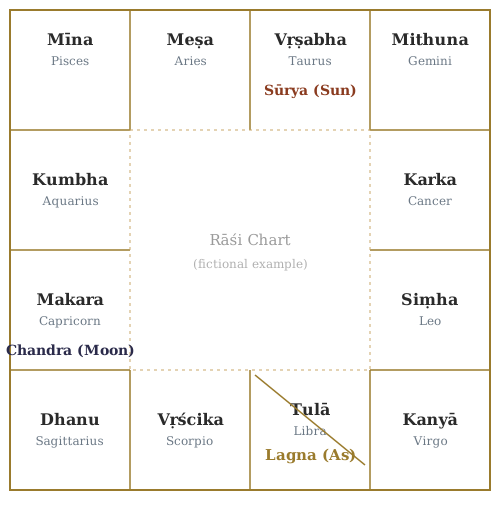
Reading this chart: the signs never move, so each rāśi always sits in the same box. Find the box marked "Lagna" — here, Tulā — and count clockwise from there to identify the houses.
North Indian and South Indian Formats
You will encounter two common chart layouts in India, and the difference confuses many beginners. They contain identical information.
The South Indian chart, shown above, is a square grid of twelve boxes. The signs are fixed in position and the Ascendant is marked with "As" or "Lagna." Houses are counted clockwise from the Ascendant box.
The North Indian chart uses a diamond-shaped design where the houses are fixed and the signs move. The topmost central diamond is always the first house, and a number written inside it tells you which sign is rising — 1 for Meṣa through 12 for Mīna. Houses are counted anticlockwise.
In Meera's chart, a North Indian layout would show the number 7 in the top-centre diamond, because Tulā is the seventh sign. Same chart, different presentation.
In Short
The Ascendant is the anchor of a Vedic birth chart. It depends on your exact birth time and place, it changes roughly every two hours, and it determines the house framework that gives every planet its meaning. If you learn only one technical concept in Vedic astrology, this is the one worth learning first.
A practical next step: find your accurate birth time, note the city, and have your Lagna calculated. Then look at where your Ascendant lord sits. That single placement will teach you more than a year of Sun sign columns.
Sources and Further Reading
On the ascendant and house calculation
- Bṛhat Parāśara Horā Śāstra, translated by R. Santhanam.
- Varāhamihira, Bṛhat Jātaka, translated by B. Suryanarain Rao.
On the sidereal zodiac and ayanāṃśa
- Swiss Ephemeris documentation (Astrodienst), for the definitions and comparison of the various ayanāṃśa values used to calculate the sidereal Ascendant.