What Is Vedic Astrology?
A plain-language introduction to Jyotiṣa — how it measures the sky, what it looks at, and why it treats timing differently to Western astrology.
Most people meet Vedic astrology through a small shock. They have known their whole life that they are a Leo, and then someone puts a Vedic chart in front of them and says, "Actually, your Sun is in Cancer."
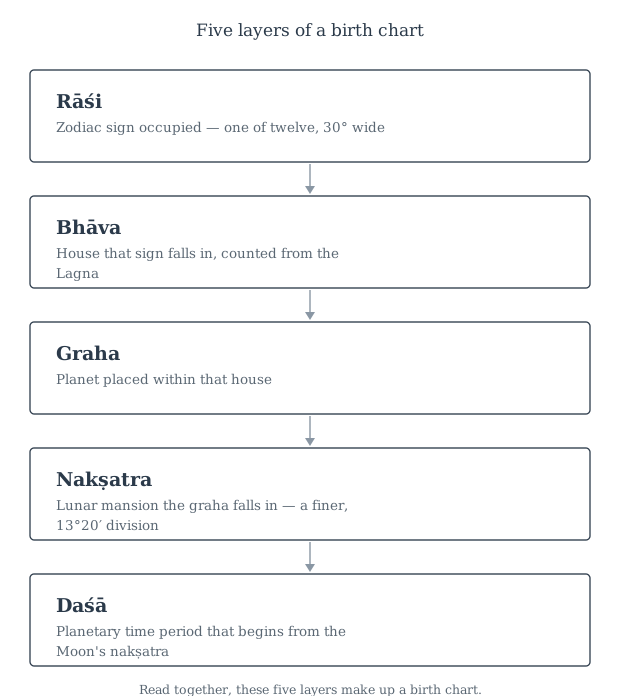
That single moment is a good doorway into the subject, because it points straight at what makes this system its own thing. Vedic astrology is not Western astrology with Sanskrit names pasted on top. It measures the sky differently, it pays attention to different points in the chart, and it is built around a question Western astrology mostly leaves alone: when.
Here is what it actually is, in plain terms.
The Name Comes First
The Sanskrit name is Jyotiṣa, from jyoti, meaning light. It is counted among the six Vedāṅgas, the supporting limbs of Vedic study, alongside subjects like grammar and phonetics. Its original job in that setting was practical and calendrical: working out the correct timing for rituals, seasons and observances.
Over centuries it grew into several branches. Gaṇita or Siddhānta handles the astronomy and the mathematics. Saṃhitā deals with collective matters like weather, harvests and public events. Horā covers the part most people mean when they say astrology, and inside it sit Jātaka (birth charts), Muhūrta (choosing favourable timing for a marriage, a journey, the start of a business) and Praśna (answering a question from the moment it is asked, without a birth time).
Classical writing on the subject is substantial and still in circulation. The Bṛhat Parāśara Horā Śāstra, Varāhamihira's Bṛhat Jātaka, Kalyāṇavarma's Sārāvalī and Maṇṭreśvara's Phaladīpikā are among the texts practitioners still study and argue about.
Why Your Sign Changes
This is the difference that trips everyone up, and it is not a matter of opinion. It is arithmetic.
Western astrology mostly uses the tropical (sāyana) zodiac, which begins at the spring equinox. Vedic astrology uses the sidereal (nirayana) zodiac, which is tied to the fixed stars.
Those two starting points used to line up. They no longer do, because the Earth wobbles slowly on its axis. This is precession of the equinoxes, and it shifts the equinox point backwards through the constellations by roughly one degree every seventy-two years. The accumulated gap is called the ayanāṃśa.
The value most widely used in India is the Lahiri ayanāṃśa, named after N. C. Lahiri, who served as secretary of the Calendar Reform Committee that the Government of India appointed in November 1952 under the chairmanship of the physicist Meghnad Saha. The committee's report was signed in November 1955, and the value it settled on became the standard for the Rāṣṭrīya Pañcāṅga, India's national almanac. It fixes the sidereal zodiac by placing the star Spica (Chitrā) at 180 degrees, which is why it is also called the Chitrapakṣa ayanāṃśa. Today it stands a little over 24 degrees, and it grows by roughly fifty arcseconds a year.
What that means in practice: subtract about 24 degrees from a tropical position and you get the sidereal one.
Take someone born on the first of January. Tropically the Sun is around 10 degrees of Capricorn. Take off 24 degrees and it lands at about 16 degrees of Sagittarius. Same Sun, same sky, different measuring stick. This is also why Makara Saṅkrānti, the Sun's entry into Capricorn in the Indian calendar, falls in mid-January rather than in late December.
Roughly speaking, anyone born in the first twenty-four days or so of a Western sign will find their Vedic Sun sits in the previous sign. Only people born near the end of a Western sign keep the same one.
The Working Parts, at a Glance
A Vedic chart is built from a small number of components. Before going through each one, here is how they relate.
| Component | What it is | How many |
|---|---|---|
| Graha | A planet (including the two lunar nodes) | 9 |
| Rāśi | A zodiac sign, 30° wide | 12 |
| Bhāva | A house, describing an area of life | 12 |
| Lagna | The rising sign at birth; anchors the houses | 1 |
| Nakṣatra | A lunar mansion, 13°20′ wide | 27 |
| Daśā | A sequence of planetary time periods | 120-year cycle |
Now the detail behind each of these.
The Nine Grahas
There are nine, collectively the Navagraha. Uranus, Neptune and Pluto were not part of the classical system, and many traditional astrologers still leave them out entirely.
| Graha | English | Traditionally signifies |
|---|---|---|
| Sūrya | Sun | Self, vitality, father, authority |
| Chandra | Moon | Mind, emotions, mother, comfort |
| Maṅgala | Mars | Energy, courage, conflict, siblings |
| Budha | Mercury | Speech, intellect, commerce, learning |
| Guru (Bṛhaspati) | Jupiter | Wisdom, teachers, children, expansion |
| Śukra | Venus | Relationships, art, pleasure, spouse |
| Śani | Saturn | Discipline, delay, labour, longevity |
| Rāhu | North lunar node | Ambition, obsession, the unfamiliar |
| Ketu | South lunar node | Detachment, loss, spiritual leaning |
Rāhu and Ketu are the points where the Moon's path crosses the Sun's, which is why eclipses happen there. They have no physical body, so they are called chāyā grahas, shadow planets, and they always sit exactly opposite each other in the chart.
Rāśis and Nakṣatras
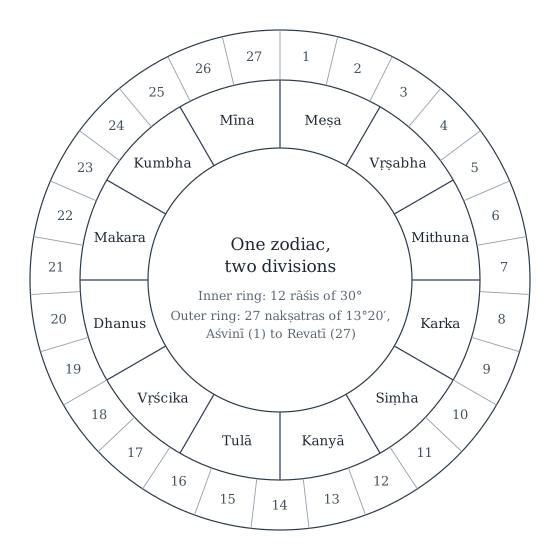
The zodiac is divided twice over. The twelve rāśis (signs) are 30 degrees each, from Meṣa (Aries) to Mīna (Pisces). The twenty-seven nakṣatras (lunar mansions) are 13 degrees 20 minutes each, from Aśvinī to Revatī. Both divisions cover the same circle, which is why every planet has a sign and a nakṣatra.
The Twelve Bhāvas
The bhāvas are the houses. They describe areas of life rather than qualities of temperament.
| House | Sanskrit name | Chiefly concerns |
|---|---|---|
| 1st | Tanu | Body, self, general direction of life |
| 2nd | Dhana | Wealth, family, speech, food |
| 3rd | Sahaja | Courage, effort, siblings, short journeys |
| 4th | Sukha | Home, mother, land, inner comfort |
| 5th | Putra | Children, intelligence, creativity, merit |
| 6th | Ari (Ripu) | Illness, debt, obstacles, service |
| 7th | Yuvati (Kalatra) | Marriage, partnership, dealings with others |
| 8th | Randhra (Āyus) | Upheaval, hidden matters, longevity |
| 9th | Dharma | Fortune, father, teachers, belief, long travel |
| 10th | Karma | Work, status, public role |
| 11th | Lābha | Gains, networks, elder siblings |
| 12th | Vyaya | Expenditure, loss, seclusion, foreign lands, sleep |
The Lagna
The Lagna is the Ascendant — the exact point on the zodiac rising on the eastern horizon at the moment of birth. Whichever sign contains that point becomes the first house, and every other house is counted from it in order. This is the anchor of the whole chart and the reason an accurate birth time matters so much. The Ascendant moves through roughly one full sign every two hours, so even a difference of twenty minutes can shift the exact degree involved, and near a sign boundary, the house structure itself.
You will also see charts drawn in two visual styles. In the North Indian diamond format the houses stay in fixed positions and the sign numbers move. In the South Indian square format the signs stay fixed and the houses move. Same information, different layout.
The Moon Matters More Than the Sun
Here is a genuine shift in emphasis. In Vedic astrology the Moon carries far more weight than in most Western practice. Ask someone in India what their sign is and the answer will often be their Chandra rāśi, the Moon sign, not the Sun sign.
Alongside it sits the nakṣatra the Moon occupies at birth, the janma nakṣatra or birth star. It is used for traditional naming, for compatibility matching, and for choosing auspicious timing.
It also does something more structural, which brings us to the part of Jyotiṣa that has no real Western equivalent.
Timing: The Daśā System
Western astrology is strong on describing character. Vedic astrology puts a lot of its energy into describing sequence, and the main tool is the daśā, a system of planetary periods.
The most widely used is Vimśottarī daśā, a 120-year cycle in which each graha rules a stretch of life in a fixed order. Which one you begin with, and how much of it is left at birth, is calculated from the exact position of the Moon within its nakṣatra.
| Graha | Period length |
|---|---|
| Ketu | 7 years |
| Śukra (Venus) | 20 years |
| Sūrya (Sun) | 6 years |
| Chandra (Moon) | 10 years |
| Maṅgala (Mars) | 7 years |
| Rāhu | 18 years |
| Guru (Jupiter) | 16 years |
| Śani (Saturn) | 19 years |
| Budha (Mercury) | 17 years |
Each mahādaśā is subdivided into antardaśās, sub-periods run by each of the nine grahas in the same order, and those subdivide again. This is how an astrologer arrives at a specific window rather than a general description: not "you are ambitious," but "the Saturn–Mercury period from this year to that year is where the career question comes to a head."
Running alongside the daśās are gochara, the transits, which describe what the planets are doing in the sky right now relative to your birth chart. The best known is sade sati, the roughly seven-and-a-half-year stretch when Saturn passes through the sign before your Moon sign, your Moon sign itself, and the sign after it.
The two are read together. The daśā sets the theme of the chapter; the transits mark the events inside it.
Reading a Sample Chart
Below is a chart in the South Indian square format. It is a fictional example. The placements were chosen to illustrate the layout clearly and are not calculated from any real birth date.
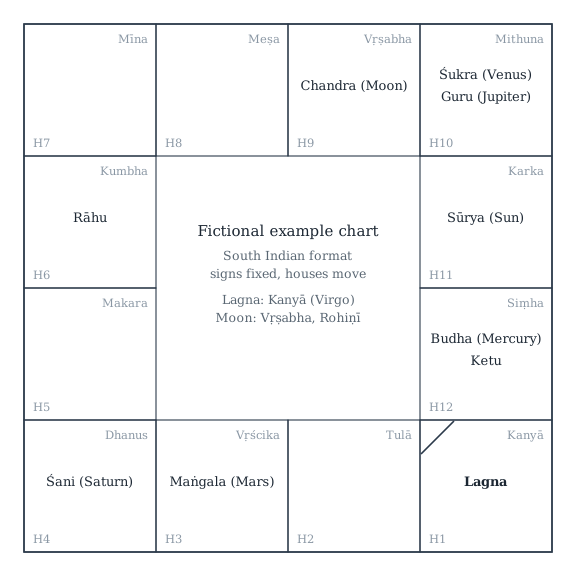
Here is what you are looking at.
The twelve boxes are the twelve rāśis, fixed in place and running clockwise from Mīna (Pisces) at the top left. Because the signs never move in this format, you always know where to find Vṛścika or Makara on the page.
The diagonal stroke in the Kanyā box marks the Lagna. That box becomes the first house, and the houses then count clockwise from it: Tulā is the 2nd, Vṛścika the 3rd, on around to Siṃha as the 12th. The small house numbers are printed in each box so you can follow the count.
Now read the placements. The Moon sits in Vṛṣabha, the 9th house from this Lagna, and within Vṛṣabha it falls in Rohiṇī nakṣatra. Rohiṇī is ruled by the Moon, which means this person began life in a Moon mahādaśā. If two years of it had already elapsed at birth, the Moon period would run until age eight, then Mars for seven years, then Rāhu for eighteen, following the order in the table above.
Jupiter and Venus sit together in Mithuna in the 10th house of work and public role. Saturn is in the 4th, Mars in the 3rd, and the nodes fall across the 6th and 12th. A practitioner would go on to check house lordships, the strength of each graha and the divisional charts, but those four steps — signs, Lagna, houses counted from it, then planets with their nakṣatras — are the whole foundation.
Yogas and Divisional Charts
Two more terms you will meet early.
Yogas are specific planetary combinations with named effects. There are hundreds of them in the classical literature, some common, many rare. A good practitioner treats a yoga as one factor among many rather than as a verdict on its own.
Vargas are divisional charts, made by subdividing each sign further and building a new chart from the result. The best known is the navāṃśa (D9), which divides each sign into nine parts and is read especially for marriage and for the underlying strength of a planet. A planet that looks strong in the main rāśi chart but weak in the navāṃśa is usually read as promising more than it delivers.
Karma, Choice and Remedies
The philosophical frame behind Jyotiṣa is karma. The birth chart is traditionally understood as a picture of prārabdha karma, the portion that has ripened and is being worked through in this life. That is a description of terrain, not a script. The tradition itself assumes effort, judgement and free will matter, otherwise the whole apparatus of upāya would be pointless.
Upāyas are remedial measures: mantra recitation, dāna (giving), fasting, temple observance, and in some traditions gemstones. This is also, honestly, the corner of the field where commercial pressure is heaviest. An astrologer who moves quickly from reading your chart to selling you an expensive stone deserves scepticism.
Where to Actually Begin
If you want to go further, a sensible order is this.
Find your birth time as precisely as you can, from a birth certificate or hospital record if possible. Generate a sidereal chart, checking that the software uses the Lahiri ayanāṃśa. Note four things: your Lagna, your Chandra rāśi, your janma nakṣatra, and the mahādaśā you are currently running. Then sit with those four for a while before you touch anything else.
Most beginners try to memorise every yoga and every aspect rule at once and end up with a pile of contradictory fragments. The four points above are the load-bearing ones. Everything else is refinement.
If you want something to work through slowly after that, I cover this same ground at book length in [Add your book title and link here], with chart construction and the daśā calculation set out step by step so you can practise on your own chart rather than only reading about someone else's.
In Short
Vedic astrology is a sidereal system, built on nine grahas, twelve signs, twelve houses and twenty-seven nakṣatras, anchored by the Ascendant and weighted heavily toward the Moon. Its real signature is the daśā system, which turns a chart from a static portrait into a sequence unfolding over a lifetime.
You do not need to believe anything to start learning it. Cast the chart, look at those four points, and see whether the timing described matches the shape of the years you have already lived. That comparison will teach you more than any amount of reading about it.
Sources and Further Reading
On the calendar and the ayanāṃśa
- Report of the Calendar Reform Committee, Government of India, Council of Scientific and Industrial Research, 1955.
- Rāṣṭrīya Pañcāṅga and The Indian Astronomical Ephemeris, published annually by the Positional Astronomy Centre, India Meteorological Department, Kolkata.
- Swiss Ephemeris documentation (Astrodienst), for the definitions and comparison of the various ayanāṃśa values.
Classical texts in translation
- Bṛhat Parāśara Horā Śāstra, translated by R. Santhanam.
- Varāhamihira, Bṛhat Jātaka, translated by B. Suryanarain Rao.
Historical background
- David Pingree, Jyotiḥśāstra: Astral and Mathematical Literature, Otto Harrassowitz, 1981.